How to create a social media content calendar
A social media content calendar is the schedule of what you'll post, where and when, with each post's status, owner and assets in one place. To build one, pick your channels and posting rhythm, mark the month's key dates, give each slot a theme, then fill the slots with finished posts and an approval step if someone signs off.
By HeyOrbit teamLast updated 5 min read
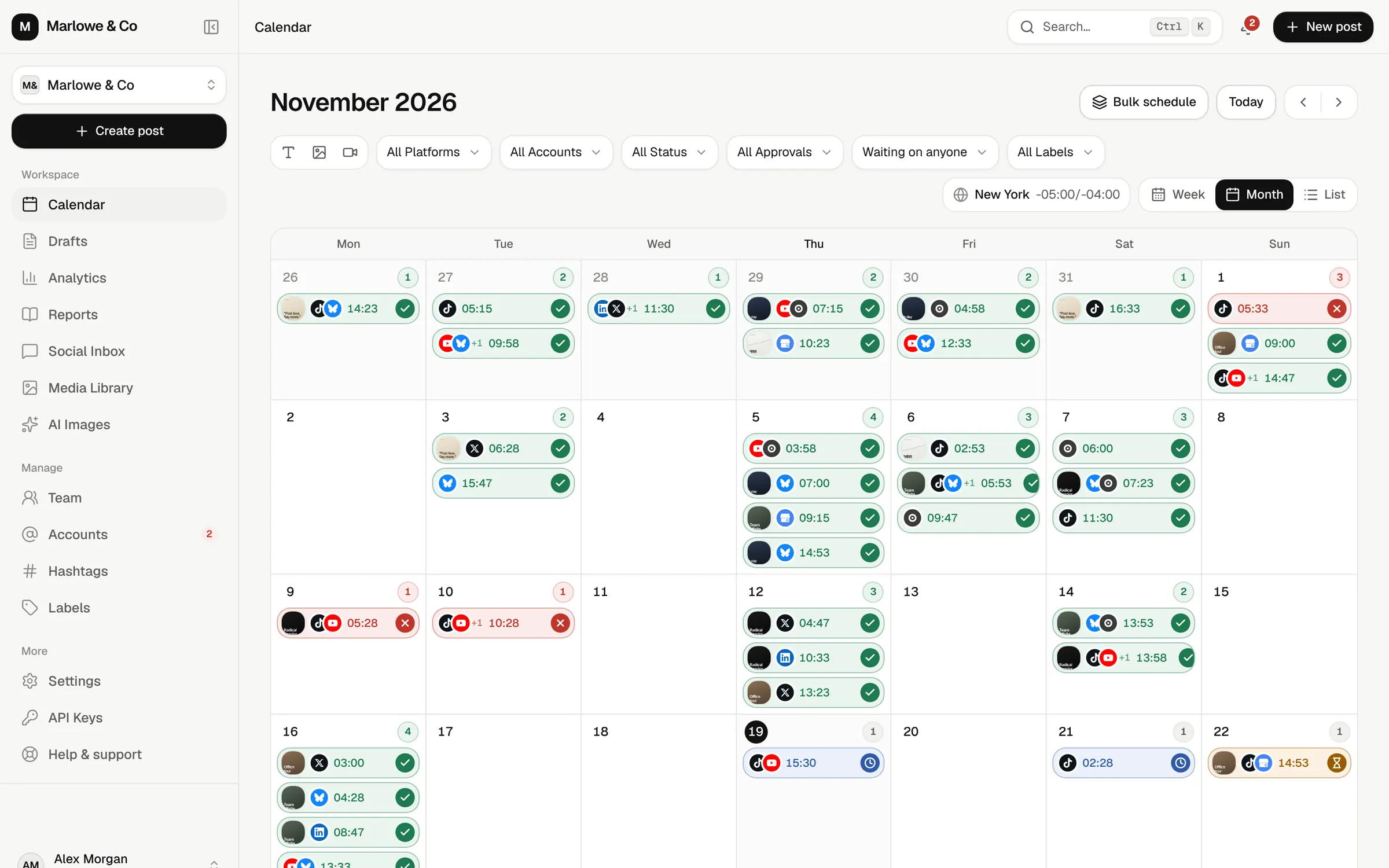
A month of posts across platforms, each with its time, platform and status.
On this page+
What a content calendar is for#
A content calendar answers four questions at a glance: what's going out this week, on which accounts, who is working on it, and what's still missing. It turns social media from a daily scramble into a plan you can review, share and improve, and it is the first thing a new teammate or approver needs to see.
The fields worth tracking#
Whether it lives in a spreadsheet or a scheduling tool, every post needs the same handful of fields:
| Field | Why it matters |
|---|---|
| Date, time and timezone | When it publishes, in the audience's timezone |
| Accounts | Which platforms and which brand's accounts it goes to |
| Post type | Feed post, carousel, Reel, Short, thread, Pin… each has its own rules |
| Caption | The final text, per platform where it differs |
| Media | The exact files, already sized for each platform |
| Link | The destination, with UTM tags if you track campaigns |
| Theme or pillar | What kind of post it is, so the mix stays balanced |
| Owner | Who writes and finishes it |
| Status | Draft, Pending approval, Scheduled, Published |
| Approver | Who signs off, if anyone |
A template you can copy#
Start with a simple grid: one row per post, the fields above as columns.
| Date | Time | Accounts | Type | Pillar | Topic | Owner | Status |
|---|---|---|---|---|---|---|---|
| Mon 2 | 09:00 | Instagram, Facebook | Carousel | Education | Five ways to use the new feature | Priya | Draft |
| Tue 3 | 12:30 | Post | Behind the scenes | How the team ships a release | Jonas | Pending approval | |
| Wed 4 | 18:00 | TikTok, Instagram, YouTube | Reel / Short | Product | 30-second demo | Priya | Scheduled |
| Thu 5 | 10:00 | X, Threads, Bluesky | Thread | Education | What we learned from customer calls | Sam | Draft |
| Fri 6 | 16:00 | Google Business Profile | Offer | Promotion | Weekend offer | Sam | Scheduled |
How to build your calendar#
Choose channels and a rhythm you can keep
List the platforms that matter for the brand and decide how many posts each gets per week. Choose a number you can sustain with the people and time you have, and raise it later.
Give recurring slots a theme
Decide what each slot is for: Monday education, Wednesday product, Friday community, for example. Themes become labels you can filter by later (content pillars).
Mark the month's key dates
Add launches, events, sales, holidays your audience cares about and anything seasonal. These get their slots first; the recurring themes fill the rest.
Fill the slots with finished posts
Write the caption, attach the media and choose the accounts for each slot. In HeyOrbit, click + on a day to start a post on that date, or schedule a batch from your media with bulk scheduling.
Add approvals where someone signs off
Turn on approvals for posts that need them, with the approvers named. Posts wait until they're approved and never publish without it (approval workflow).
Review the calendar every week
Filter by status to find drafts and posts waiting on someone, drag posts to new days when plans change, and fill any gaps.
Spreadsheet or scheduling tool?#
A spreadsheet is free and flexible, and fine for planning. It falls short on the last mile: someone still has to copy every caption into every app at the right time, check each platform's limits by hand, and chase approvals over email. A scheduling tool keeps the plan and the publishing in one place: the calendar is the schedule, statuses update themselves, and posts go out on their own.
In HeyOrbit the calendar has week, month and list views, filters by account, status, approval state and label, drag-and-drop rescheduling, and a timezone pill that names the workspace timezone every time follows (using the calendar). Labels work as the pillar column, and the approval filters replace the "who's this waiting on?" message.
Common mistakes#
- Planning further ahead than you can produce. A plan with slots nobody can fill is worse than a shorter plan. Plan a month in detail and the following months as themes and key dates.
- No owner per post. "The team" doesn't finish posts. Give every post a name.
- One calendar for several brands. Mixing brands on one calendar is how posts end up on the wrong account. Keep one calendar (in HeyOrbit, one workspace) per brand.
- The wrong timezone. Schedule in the audience's timezone, not yours. Set it once on the workspace (timezones).
- No time for approvals. If someone signs off, schedule posts far enough ahead that they can review without rushing.
- Never looking back. Once a month, check what worked and adjust next month's mix (analytics).
FAQ
What should a social media content calendar include?
For each post: the date, time and timezone, the accounts, the post type, the caption, the media, the link, the theme or pillar, the owner, the status and the approver if there is one.
How far ahead should I plan?
A workable rhythm is a month of finished posts, with the following months sketched as themes and key dates. Plan only as far ahead as you can actually produce.
Is a spreadsheet good enough?
For planning, yes. For publishing, a scheduling tool saves copying every post into every app and keeps statuses and approvals current without manual updates.
How do I keep several brands apart?
Give each brand its own calendar. In HeyOrbit that's a workspace per brand, with its own accounts, team, labels and timezone.
Can people who don't post see the calendar?
Yes. Invite them as Reviewers or Viewers: they see the calendar and can comment, and Reviewers can approve, without being able to publish.
Keep reading
- Planning and cross-postingHow to plan a month of social media content in a dayPlan a month of social media posts in one focused day: review last month, map key dates, theme each slot, batch-create posts and schedule in one go.
- Planning and cross-postingSocial media content pillars: what they are and how to choose yoursContent pillars are the few themes a brand posts about. How to choose three to five from your goals and audience, with examples, and how to measure them.
- Teams and approvalsHow to set up a social media approval workflowSet up a social media approval process with one approver or several steps: who signs off, what they see, what a rejection does, and how to keep it fast.
- Teams and approvalsHow to manage multiple brands on social media without mixing them upRun several brands, clients or regions from one login: a workspace per brand, separate teams and timezones, per-brand branding, and a routine that scales.
In the help centre